Project overview
This was a client-facing enterprise AI Agent and low-code platform selection study. The goal was to establish a reusable decision framework for rapid pilots, sustained adoption by business teams, and expansion into additional scenarios.
- Project work: Apr–May 2026; client delivery: Jun 2026.
- Platforms: Tencent ADP, Alibaba Bailian, and Volcano Coze, with the Coze-to-HiAgent enterprise path considered for private or enterprise deployment.
- Focus: not a list of model benchmarks, but whether each platform could combine agent building, knowledge, workflows, multimodal creation, systems integration, and enterprise governance into a deliverable product path.
- Evidence base: public product documentation, vendor materials, industry sources, and enterprise-delivery judgment. Information was reviewed through 2 Jun 2026.
Report outline
The delivery set contains one consolidated report and five supporting appendices. It moves from an executive decision view to the assessment matrix, target architecture, scenarios, and security boundaries.
- Executive overview: the main conclusion, recommendation logic, implementation guidance, and key risks.
- Recommendation: preferred platform direction, alternative paths, assumptions, trade-offs, and pre-purchase validation actions.
- Detailed assessment matrix: a consistent 1–5 scale across platform-owned capabilities, ecosystem, application layer, security governance, cost, and delivery, with scoring rules and assumptions.
- Framework and blueprint review: a reusable three-layer architecture connecting business entry points, the Agent platform, and the enterprise governance foundation.
- Scenario and capability appendix: mapping media monitoring, employee knowledge, HR automation, video production, subscription reporting, and SaaS delivery to platform capabilities.
- Data security and privacy appendix: data use, encryption, isolation, access control, auditability, incident response, and boundaries requiring contract or POC confirmation.
Research boundary and platforms
The assessment focused on the low-code Agent platform layer of the AI stack. It evaluated integration depth across models, knowledge, tools, workflows, and governance rather than judging one model's general benchmark performance.
| Platform | Position in the study | What was examined |
|---|---|---|
| Tencent ADP | Enterprise Agent development and governance platform | WeCom entry, identity and permissions, workflows, multi-agent collaboration, audit, and SaaS-to-cloud deployment path |
| Alibaba Bailian | Model and Agent engineering platform | DingTalk ecosystem, MCP services, model routing, private-network access, and engineering controls |
| Volcano Coze | Low-code Agent building with an enterprise extension path | AI-generated workflows, multimodal creation, plugin and skill ecosystem, business-user iteration, and Coze-to-HiAgent delivery |
Assessment framework and scoring
Weight structure
| Assessment layer | Weight | Main dimensions | Decision question |
|---|---|---|---|
| Platform-owned capability | 65% | Integration and openness, Agent core, security and governance, extensibility and delivery, platform cost | Is the platform itself complete, governable, and deliverable? |
| Ecosystem capability | 25% | Models and inference, multimodal and information access, infrastructure | Do models, search, RAG, and sandboxes work as one system? |
| Application capability | 10% | UX & Adoption | Can non-technical users understand, use, and improve the applications? |
The first layer is split into integration and openness 15%, Agent core 20%, security and governance 10%, extensibility and delivery 10%, and platform cost 10%. The second layer covers models and inference 15%, multimodal and information access 5%, and infrastructure 5%. The third layer observes multimodal interaction, mobile access, and multilingual experience.
Five-point scale
| Score | Meaning | Rule of thumb |
|---|---|---|
| 5 | Leading | Native, deep support with public or verifiable evidence and no known critical gap |
| 4 | Meets needs | Productized and usable, with local limits or non-native integration |
| 3 | Usable with limits | Basic support, but weaker than peers or dependent on workarounds |
| 2 | Insufficient | A key capability is missing and requires substantial customization |
| 1 | Not supported / undisclosed | Explicitly unavailable or not evidenced in public materials |
Scores express relative maturity and direction, not a linear capability ratio. KPI calculations retain two decimals internally and show one decimal in the total. A real-world POC remains necessary before procurement.
Decision gates
- Must-have: enterprise security and China data residency, visual workflow orchestration, and at least one major collaboration-entry integration.
- Priority: deep MCP integration, multi-agent collaboration, cross-session memory, model routing, low-cost model access, and SaaS-to-enterprise migration.
- Acceptable trade-offs: third-party components or ecosystem binding can be accepted when the risk is recorded and a mitigation path is planned.
Platform comparison summary
Weighted result
| Rank | Platform | Weighted total | Layer 1 | Layer 2 | Layer 3 |
|---|---|---|---|---|---|
| 1 | Volcano Coze | 90.6 | 58.3 | 23.3 | 9.0 |
| 2 | Tencent ADP | 88.6 | 58.1 | 22.3 | 8.2 |
| 3 | Alibaba Bailian | 84.0 | 56.6 | 18.8 | 8.6 |
Key dimension observations
| Dimension | Tencent ADP | Alibaba Bailian | Volcano Coze |
|---|---|---|---|
| Agent orchestration | 4.8: strong workflow nodes, multi-agent modes, and human-in-the-loop | 4.0: mature visual workflows, but weaker natural-language workflow generation | 5.0: AI-generated workflows, project collaboration, and Agent delegation are more balanced |
| MCP and system connectivity | Strong entry integration and MCP paths; MCP score 4.2 | MCP score 4.6, with a relatively complete hosting, billing, and governance path | MCP score 4.2; gateway and Serverless paths need enterprise-network validation |
| Security and governance | Governance and audit 5.0; content safety 4.0 | Governance and audit 5.0; content safety 4.0 | Governance and audit 5.0; content safety 4.0 |
| Extensibility and delivery | 4.5; WeCom and Tencent Cloud are the main specialization | 3.5; private delivery exists, but enterprise support and SLA need confirmation | 4.5; SaaS and HiAgent paths are clear, but cross-version migration needs proof |
| Platform cost TCO | 4.0; license, components, and deployment depend on the solution | 4.0; no seat fee, but cloud resources are usage-based | 4.0; enterprise seats and resources depend on scale |
Recommendation logic
- Volcano Coze was recommended for the rapid pilot and first implementation path, especially for low-code building, multimodal scenarios, and continuous iteration by business teams.
- Tencent ADP remains the comparison and alternative path for deep WeCom, identity, and permission integration. Its advantage depends on whether the Tencent ecosystem is a real delivery constraint.
- Alibaba Bailian remains a longer-term technical option for DingTalk ecosystems, MCP engineering, and complex model-routing scenarios.
- Total scores do not replace scenario judgment. A hard requirement for WeCom entry, identity synchronization, or private networking can change the final order; a priority on self-service building and fast iteration favors Coze.
Scenario-to-capability map
| Scenario | Business goal | Key tasks | Platform capabilities | First validation focus |
|---|---|---|---|---|
| Media / crisis monitoring | Improve monitoring and reporting speed | Search, knowledge analysis, report generation | AI search, RAG, workflows, source traceability | Freshness, source quality, report time |
| Employee knowledge base | Improve self-service access | Multimodal document understanding, Q&A, report generation | Multimodal, permissioned knowledge, memory, citations | Permission filtering, traceability, updates |
| Low-code Agent environment | Let teams build quickly | Template reuse, visual orchestration, tools | Agent workflows, plugins, MCP, collaboration | Onboarding time, change cost |
| HR and recruiting automation | Reduce repetitive work | Candidate search, fit analysis, interview summaries, reports | Search, workflows, structured output, system write-back | Human review, privacy, write-back |
| Enterprise knowledge management | Reuse organizational knowledge | Meetings, chats, and training capture | RAG, vector store, permissions, audit | Lifecycle, inheritance, retrieval quality |
| End-to-end video production | Support content commercialization | Asset understanding, scripts, video generation | Multimodal models, workflows, asset management | Processing chain, review, consistency |
| Subscription reporting | Productize monitoring services | Scheduled jobs, report distribution, business permissions | Scheduled workflows, tenants, usage tracking | Reliability, distribution, cost attribution |
| Custom business solutions | Support project delivery | Template reuse, custom Agents, isolation | Low-code, reusable tools, tenant isolation | Delivery reuse, change impact |
| SaaS delivery | Support platform operations | Tenants, deployment, operations, metering | Enterprise/private deployment, tenants, audit | Version migration, operations, SLA |
Reusable architecture blueprint
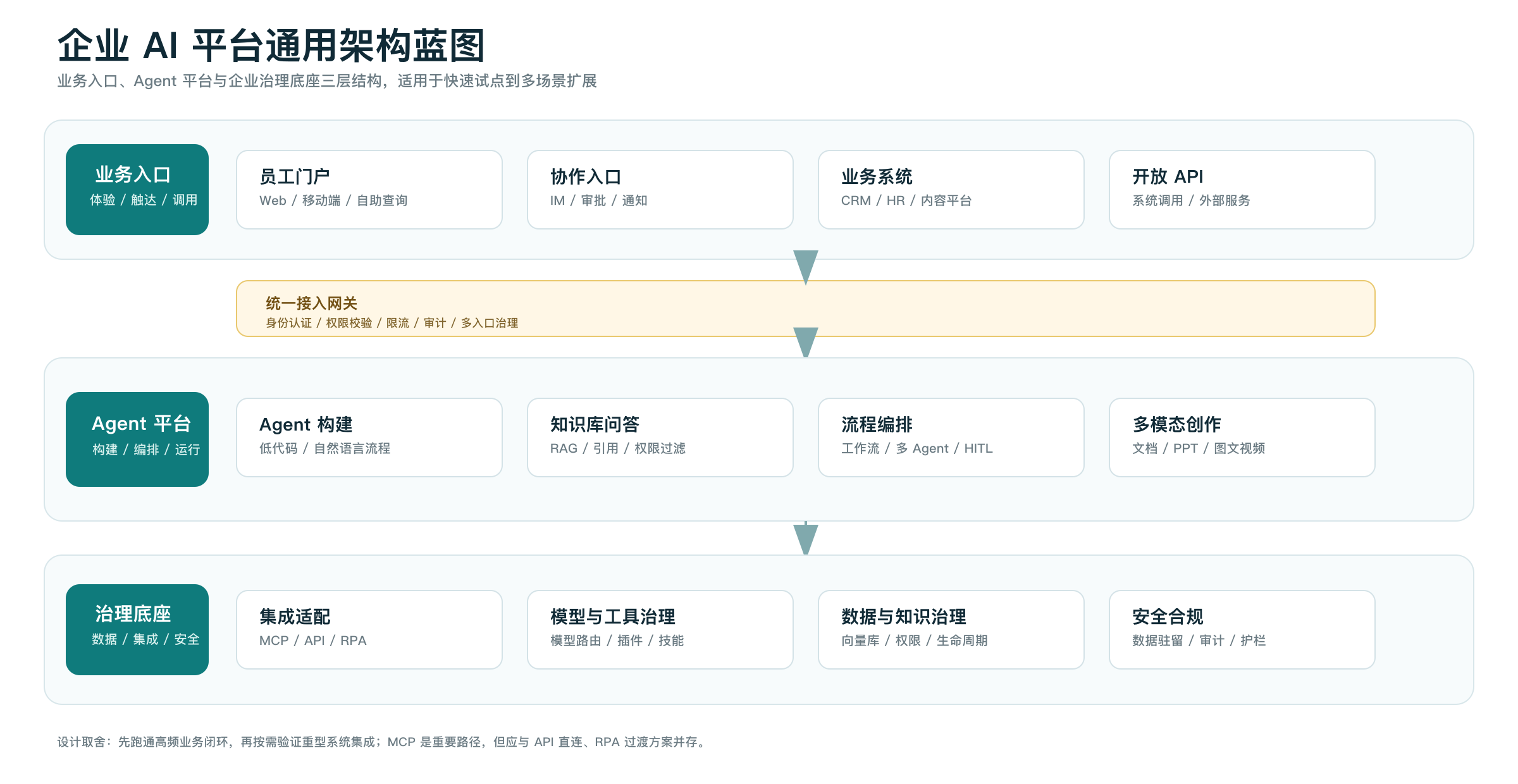
The blueprint separates enterprise AI delivery into three connected layers so that entry points, capabilities, and governance can evolve independently:
- Business entry layer: employee portals, WeCom / DingTalk / Lark, business systems, and open APIs. An entry gateway handles identity, permission checks, rate limits, callbacks, and audit.
- Agent platform layer: Agent building, knowledge Q&A, workflow orchestration, multi-agent collaboration, multimodal creation, and business-user iteration.
- Enterprise governance foundation: model and tool governance, MCP / API / RPA adapters, knowledge and vector stores, structured and unstructured data, residency, and security audit.
The key trade-off is to use the selected main platform for high-frequency scenarios first, while putting heavy ERP / HRIS integration into a later workstream. MCP is an important integration path, but API direct calls and RPA transition paths remain useful alternatives.
POC validation route
Run a lightweight POC before procurement. Use representative business samples to measure platform capability, integration effort, and adoption cost.
- Coze mainline: build one or two knowledge, report, multimodal, or business-assistance scenarios. Record build time, output quality, human review points, and iteration cost.
- ADP comparison: validate WeCom login, organization sync, permission inheritance, message entry, and mobile use.
- Internal API to MCP: choose one or two APIs and test wrapping, authentication, timeouts, errors, Agent calls, and audit logs end to end.
- Knowledge permission isolation: use role-specific documents to confirm retrieval filtering and source citations.
- Multimodal and peak load: use PDFs, spreadsheets, slide decks, images, or video to test parsing quality, latency, and retrieval under load.
- Commercial, migration, and SLA: confirm enterprise pricing, Token and application-level usage, SaaS-to-enterprise/private migration, export, and support scope.
Minimum acceptance checklist
| Check | Minimum acceptance |
|---|---|
| Representative Agent flow | A business user completes one end-to-end task with explicit success, review, and failure branches |
| Knowledge | Permission filtering works, answers cite sources, and updates produce controlled results |
| System integration | API / MCP calls have authentication, timeout, error handling, and audit logs |
| Collaboration entry | Login, organization sync, role mapping, and message entry fit the existing identity system |
| Cost and operations | Usage can be tracked per application or Agent and explained from pilot to scale |
| Delivery and migration | Configuration, data, and permission boundaries are clear across pilot, enterprise, and private versions |
Risks and implementation guidance
| Risk | Impact | Guidance |
|---|---|---|
| Domestic collaboration ecosystem binding | Identity, organization, and permission loops are deepest in each vendor's own IM ecosystem | Measure entry integration effort with representative scenarios rather than choosing by IM brand |
| Coze and HiAgent transition | A pilot-to-enterprise move may require data, configuration, and permission migration | Fix the version level early and test migration and feature parity |
| International ERP integration | Workday and SAP usually lack prebuilt connectors and need customization | Avoid heavy ERP in the first pilot; evaluate API, MCP, and RPA together later |
| MCP maturity | Protocol implementations, tool quality, Streamable HTTP, and OAuth 2.1 support differ | Prefer maintained services and test private-network calls, authentication, and recovery |
| Large-document retrieval | Parsing, indexing, and retrieval latency can become a bottleneck | Simulate peak load and reserve an indexing and retrieval tuning cycle |
| Cost and SLA definitions | List prices, discounts, components, model Tokens, and implementation may be separate | Build TCO from real quotes and usage; confirm SLA and support boundaries separately |
Main deliverables
- 00-executive-overview: executive overview and one-page conclusion.
- 01-recommendation-summary: platform recommendation, alternatives, and validation actions.
- 02-platform-assessment-matrix: candidate platforms, KPI weights, scoring rules, detailed matrix, and ranking.
- 03-framework-blueprint-review: three-layer architecture, component dependencies, and trade-offs.
- 04-scenario-capability-appendix: scenario inventory and capability map.
- 05-platform-data-security-appendix: data use, security controls, audit, and incident response comparison.
- Consolidated report HTML reading version, architecture image, POC checklist, and implementation risk notes.
Public scope
This page is a public summary of the original client report. It focuses on research scope, analytical method, delivery structure, and reusable architecture thinking. It is not a procurement recommendation or a client project postmortem.